The Places That Feel Like Home (Even When They Aren’t)
Some places stay with us longer than we stay with them.
A road. A town. A house we never owned. A porch we only sat on a handful of times. A mountain view we passed so often it became part of the background, until one day we realized the background had been holding us up.
Home is supposed to be simple. An address. A key. A place where the mail comes and the dogs know which window to look out of.
But it rarely stays that tidy.
Sometimes home is a stretch of road you could drive with half your mind somewhere else. Sometimes it is the way the air changes when you get closer to the mountains. Sometimes it is a town where you knew exactly which gas station had the good Coke, which back road would get you there faster, and which turns made your shoulders drop without asking permission.
Sometimes home is not where you end up.
Sometimes it is where you finally felt like yourself for a while.
I think we get attached to places because they keep versions of us we do not know how to carry anymore. They hold the smaller details. The ordinary ones. The ones that do not sound important when you explain them, but somehow matter more than the dramatic parts.
The porch light.
The curve in the road.
The sound of gravel under tires.
The mountains showing up like they had been waiting on you.
A place can become important because of who we were there. Or who we were trying to be. Or who we stopped pretending to be.
White Bluff was the first place that truly felt like home to me. Not because it was perfect. I am suspicious of perfect, mostly because I have met me. But it gave me something I did not realize I had been needing. Stability. Familiarity. A sense that my life had a shape I recognized.
Before that, I had lived in downtown Nashville for two years. Nashville was part of my story, and an important one, but it did not magically fix everything. Which was rude, honestly. I had moved there with the kind of hope that believes a new city might come with a new version of you already built in. Nashville, to its credit, never agreed to that arrangement.
Then came White Bluff.
Four years there taught me that home does not always announce itself. Sometimes it just becomes the place where your body stops bracing so much. The place where you learn the roads without needing directions. The place where the smallest routines start to feel like proof that you belong somewhere.
And then life changed.
I did not leave because I was ready to move on. A stalking situation made staying impossible, and it changed the course of my life in ways I am still learning how to name. I can say that plainly now, but plain does not mean small. It changed my sense of safety. It changed what home meant. It changed how quickly a place can go from comfort to complicated.
That is the strange thing about places. They can hold comfort and pain at the same time. They can be the place you loved and the place you had to leave. They can be the backdrop of some of your happiest ordinary days and still become somewhere you cannot stay.
Two things can be true, which is deeply inconvenient and usually how life works.
I think that is why places linger. They do not sort themselves into clean categories for us. Good place. Bad place. Place I miss. Place I survived. Place I outgrew. Place that outgrew me.
Most places are messier than that.
A house can be where you felt safe until you didn’t. A town can be where you belonged until belonging got complicated. A road can be familiar enough to comfort you and still lead somewhere you never wanted to go.
And still, the attachment remains.
Maybe because our memories are not filed by logic. They are filed by sensory evidence. The way the light hit a kitchen floor. The smell of summer rain on pavement. The particular silence of a back road at dusk. The mountains in the distance, steady and unbothered, like they missed the meeting where everyone else decided to panic.
Places remember differently than people do. They do not explain. They do not defend themselves. They just sit there, holding whatever happened.
That can be comforting.
That can be unfair.
Usually both.
There are roads in Tennessee that feel more familiar to me than certain conversations I have had with people I have known for years. Roads have a way of becoming emotional without trying. You take them to work. To someone’s house. Away from someone’s house. Toward news you are not ready for. Away from a version of yourself you can no longer afford to keep being.
At first, a road is just a way to get somewhere.
Then one day, it has history.
You remember exactly where you were when you made a phone call. Where you cried so hard you had to pull yourself together before walking in somewhere. Where the dogs fell asleep in the backseat of the Jeep like the world had not tilted at all. Which, honestly, dogs are very committed to reminding us that our emotional emergencies are not always their emergencies.
Cash has always had a way of making a place feel safer just by being in it. Rylee brings joy into a room like she was personally invited by sunshine. Sox can turn any house into a comedy routine with furniture. Ozzie, opinionated little king that he is, has strong feelings about almost everything.
Animals understand home in a way people complicate. They do not care if the place is impressive. They care if their people are there. If the routines make sense. If the corner is theirs. If the floor has enough good spots for a nap.
Maybe we are not that different.
We like to pretend home is about permanence, but sometimes it is about recognition. The feeling of arriving somewhere and not having to perform. The feeling of knowing where the light switches are. The feeling of being able to breathe without explaining why you needed to.
A place becomes home when it starts keeping your ordinary life.
Not the big moments, necessarily. The small ones. The unphotographed ones. The nights you ate whatever was easiest because you were too tired to be a person with standards. The mornings you stood in a doorway staring at nothing. The times you walked outside just to check the weather and somehow ended up feeling a little less alone.
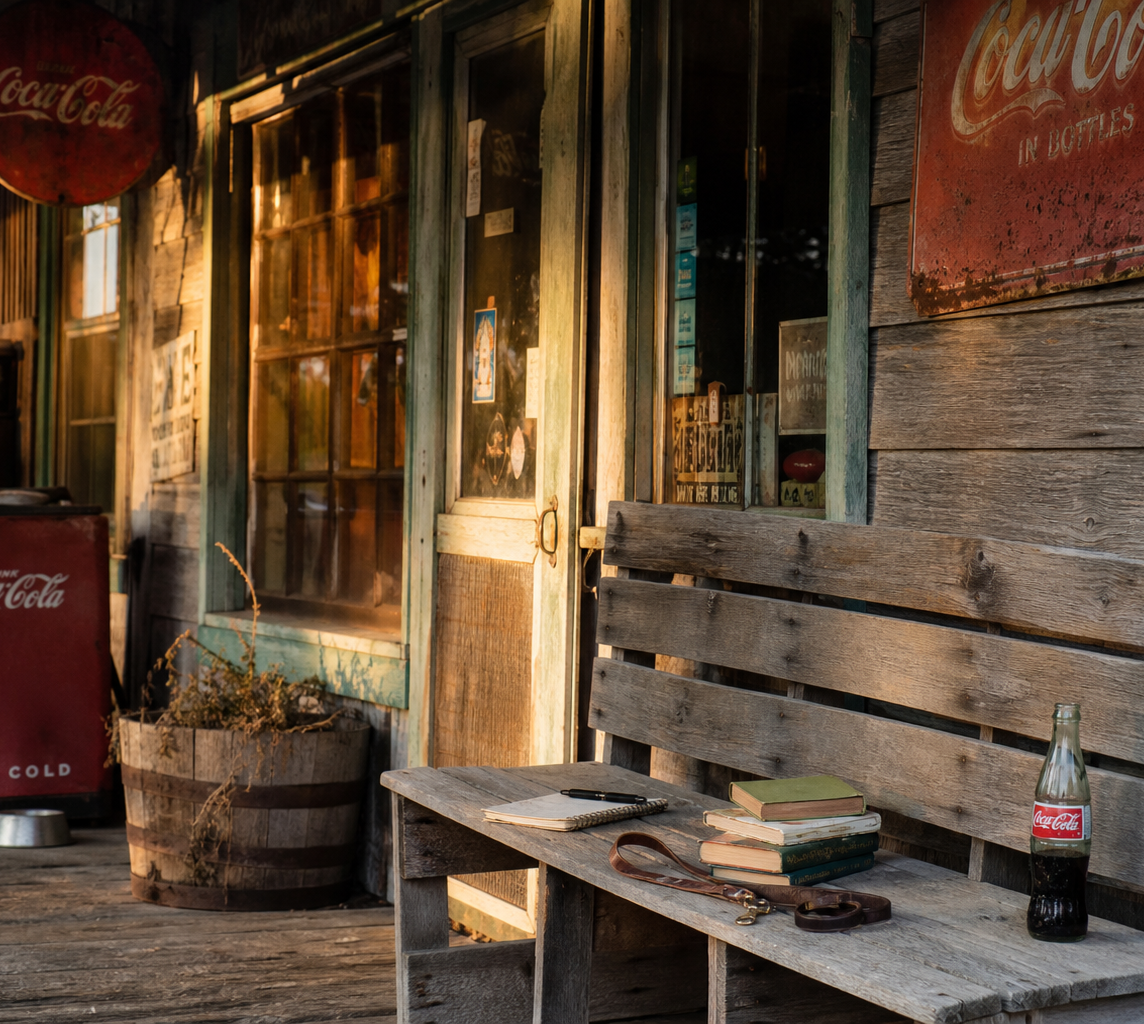
Porches are good at this.
A porch is rarely the main event, which is probably why I trust it. It is a threshold. Not fully inside, not fully outside. A place to pause. To sit with a drink in your hand and no real plan. To watch the day decide what it is going to do.
Some porches feel more honest than rooms. Rooms ask you to live inside them. Porches let you hover. Think. Avoid a text. Reconsider your entire life in a way that feels casual because you are technically just sitting down.
Houses have their own kind of memory too. Even houses that were never ours. A friend’s house. A relative’s house. A rental. A place you stayed for a little while and thought would be temporary, right up until it shaped you.
There are houses that become landmarks in our emotional lives. Not because of the architecture. Because of who we were when we walked through the door.
The house where you healed a little.
The house where you waited.
The house where you stopped waiting.
The house where you learned that peace can feel strange when you are used to chaos.
The house where you realized you did not want to be needed as badly as you wanted to be loved.
That one will sit you down.
We attach to landscapes the same way. Mountains, fields, tree lines, rivers, stretches of road where the sky opens up. They become part of how we understand ourselves. Not in a dramatic way. More like they quietly remind us that the world is bigger than whatever is loudest in our chest.
Mountains have always done that for me.
They do not fix anything. I do not want to make them sound like therapy with better scenery. But they help me remember scale. They make my life feel both small and held, which is a strange combination, but not a bad one.
There is comfort in something that was there before you figured things out and will still be there after you change your mind again. Which, if you are me, could be by Thursday.
Towns can feel that way too.
Small towns especially have a way of making memory unavoidable. You cannot reinvent yourself too aggressively in a place where someone remembers what your car looked like three years ago. There is something annoying and tender about that. The familiarity can feel comforting until it feels too close. The same street that makes you feel known can also make you feel watched.
Again, inconvenient. Again, true.
Maybe that is why the places that feel most like home are rarely simple. They know too much.
They know who we loved.
They know what we ignored.
They know where we went when we were trying to calm down.
They know the errands we ran to avoid sitting still.
They know the exits we took when staying became impossible.
And somehow, even after we leave, they stay alive inside us.
Not as perfect memories. Not as postcards. More like rooms we can still walk into if the right song comes on or the weather shifts a certain way.
I do not think every place that feels like home is meant to be permanent. Some places are chapters. Some are shelters. Some are mirrors. Some are bridges, even if we only realize that later.
A place can matter deeply and still not be where you stay.
That has been hard for me to accept at times. I like meaning to come with instructions. I want life to say, “This mattered because of this, and now you may move forward in a calm and organized manner.”
Apparently, I wanted reality to arrive with paperwork.
It has not.
Instead, I have learned that home can be real even when it is temporary. The feeling was not fake just because it changed. The belonging was not wasted just because it ended. The comfort was not meaningless just because life required me to leave.
Some places give us something we needed at the time. A slower pace. A sense of safety. A place to rebuild. A porch to sit on. A road to memorize. A view that made the day feel less impossible.
And then, sometimes, we have to go.
Leaving does not erase what a place was.
It just changes the relationship.
Maybe home is less about ownership than intimacy. Not romantic intimacy. The quieter kind. The kind that comes from repetition and attention. From knowing the back way. From recognizing the seasons by how the light hits the road. From remembering who you were in a place, even if you are not her anymore.
There are places I carry because they carried me first.
Some of them I can return to.
Some of them I cannot.
Some of them exist differently now because I do.
That is the part people do not always tell you about home. It moves. It changes shape. It becomes a town, then a person, then a dog sleeping against your leg, then a mountain view, then a house you had to leave, then a version of yourself you are still trying to understand.
And sometimes, if you are lucky, home becomes less of a place you are searching for and more of a feeling you learn to recognize.
Not always easily.
Not always permanently.
But enough to know when it is there.
A certain road.
A familiar porch.
The mountains in the distance.
The dogs settled in the backseat.
A Coke from the gas station.
No big revelation.
Just that small, strange feeling of being held by a place that does not technically belong to you.
And maybe that is enough.
Maybe some places are ours because they changed us.
Maybe some places are ours because, for a little while, we could breathe there.